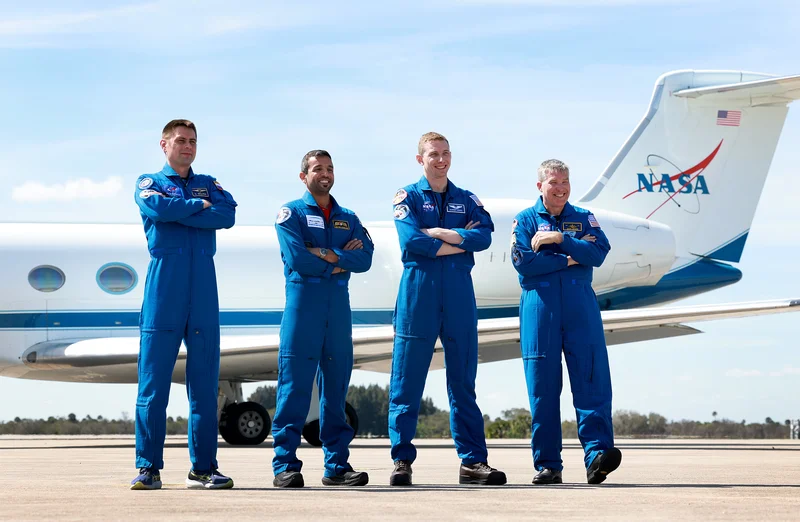
WEAVERVILLE, N.C. — While NASA and SpaceX prepare to launch four people to the International Space Station on Monday from Florida's Kennedy Space Center, a North Carolina company has done its part for the Crew-6 mission.
There's one crucial thing every launch needs before leaving the planet — a mission patch. The coaster-sized piece of embroidery adorns the crew's flight suits, each unique to the mission at hand, and has a decades-long history.
The story of the patch that is sewn into the historical fabric of spaceflight begins in a factory situated in the shadows of North Carolina's Blue Ridge Mountains, robotic sewing needles rise and plunge at blurring-fast speeds, weaving blue, orange and black thread into a three-and-a-half inch circular patch.
Machines at A-B Emblem stitch a NASA patch for the International Space Station's Expedition 67 Mission.
Brendan Byrne/WMFE
A-B Emblem is a manufacturing company in Weaverville, N.C. that's been family run for five generations. It has produced mission patches for NASA since Apollo 11 — the first lunar landing mission that took Neil Armstrong and Buzz Aldrin to the surface.
Owner Bernie Conrad said the first ones were manufactured on embroidery looms and hand threaded. Now, the process is mostly automated. "We started off with machines that were like eight heads, 12 heads, now we're up to 44 heads," he said over the sounds of the embroidery machines on his factory floor. "God knows where we're gonna go [in the] next few years."
The origins of mission patches date back to spaceflight's early days. In the Mercury program, astronauts named their capsules as a way to personalize the mission. During NASA's Gemini program, that tradition went away.
4 Astronauts Splash Down In SpaceX Dragon Capsule After 6 Months In Orbit
SPACE
4 Astronauts Splash Down In SpaceX Dragon Capsule After 6 Months In Orbit
Gemini astronaut Gordon Cooper still wanted to do something. "He came to NASA and proposed to them and said 'let us at least personalize something about our mission. Let's design a patch,'" said Robert Pearlman, a space historian and editor of collectSPACE.com.
That mission aimed to set a space endurance record of eight days. Its mission patch was a Conestoga wagon with the crew's names, Gordon Cooper and his crewmate Pete Conrad, embroidered below. And hidden beneath some fabric sewn into the patch was the inscription "eight days or bust" which only was revealed once the capsule returned successfully.
The tradition stuck. "Most of the crews took it upon themselves to at least come up with a basic design," said Pearlman. "They worked with an artist, either at one of the contractors or at NASA to perfect and make it into a usable patch."
Through Apollo and the Space Shuttle programs, the practice of patches continued. Even today, astronauts play a crucial role in the creation of their own mission patch, sometimes drawing the artwork for the final piece.
Comments
Post a Comment