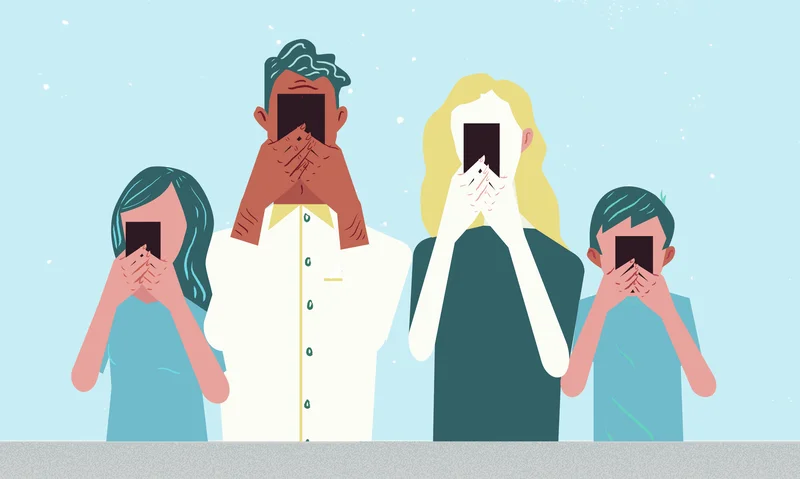
U.S. teens spend more than eight hours a day on screens, and there's growing concern over how social media may affect their mental health.
Now, a new study, published Thursday by the American Psychological Association, validates what some parents have experienced when their teenagers cut back: They seem to feel better about themselves. I've seen this in my own kids when they return from summer camp, where phones are not allowed. They seem more at ease and less moody.
Social media can feel like a comparison trap, says study author Helen Thai, a doctoral student in psychology at McGill University. Her research found that limiting screen time to about one hour a day helped anxious teens and young adults feel better about their body image and their appearance.
Her research arose from her own personal experiences.
"What I noticed when I was engaging in social media was that I couldn't help but compare myself," Thai says. Scrolling through posts from celebrities and influencers, as well as peers and people in her own social network, led to feelings of inferiority.
"They looked prettier, healthier, more fit," Thai says. She was well aware that social media posts often feature polished, airbrushed or filtered images that can alter appearances in an unrealistic way, but it still affected her negatively.
So, Thai and a team of researchers decided to test whether slashing time on social media platforms including Instagram, TikTok and Snapchat would improve body image. They recruited a few hundred volunteers, aged 17-25, all of whom had experienced symptoms of anxiety or depression — which could make them vulnerable to the effects of social media.
Half of the participants were asked to reduce their social media to 60 minutes a day for three weeks, Thai says. The other half continued to use social media with no restrictions, which averaged about three hours per day.
The researchers gave the participants surveys at the beginning and end of the study, that included statements such as "I'm pretty happy about the way I look," and "I am satisfied with my weight." Among the group that cut social media use, the overall score on appearance improved from 2.95 to 3.15 on a 5-point scale. This may seem like a small change, but any shift in such a short period of time is striking, the authors say.
10 things to know about how social media affects teens' brains
EDUCATION
10 things to know about how social media affects teens' brains
"This randomized controlled trial showed promising results that weight and appearance esteem can improve when people cut back on social media use," wrote psychologist Andrea Graham, co-director of the Center for Behavioral Intervention at Northwestern University, who reviewed the results for NPR.
Graham says it's encouraging that college students were willing to cut back screen time, even for three weeks. "This provides some evidence that it may be feasible to engage this age group in reducing social media use," she says. Though this study included people who had symptoms of anxiety or depression, Graham says it's worth evaluating this approach with other groups, such as people with or at risk of eating disorders. It's also possible the benefits of cutting back could extend more broadly to anyone in this age group.
Social media platforms are always evolving and attracting young users. "The digital world is here to stay," says Thai. So, she says, the question becomes, "how do we adapt to this new world in a way where it wouldn't negatively impact us or control us?"
Here are some ideas to try:
1. Curate your social media feed to limit content that makes you feel bad
Instagram and TikTok are filled with idealized images of bodies. Filters can help people appear slimmer, more tan or wrinkle-free. "The algorithm is pushing body-centric content to you because that's what sells," says Lexie Kite, co-author with her twin sister of More Than a Body: Your Body is an Instrument, Not an Ornament. She says social media platforms can amplify harmful cultural messages — especially for girls and women — that they are most valued for their beauty and sex appeal.
So, it's up to the user to push back. "Be incredibly mindful, as you scroll, of how each creator, each image, each account makes you feel," Kite says. If a post or story makes you feel uncomfortable or less-than, make a choice to mute or unfollow. "That's what I do," Kite says. "You are the only one who can curate your feed."
2. Schedule a one-day break from devices each week
Artist and film-maker Tiffany Shlain says there's a power to unplugging one day a week. She turns off her devices every Friday evening, and takes a 24-hour break, that she now refers to as "Tech Shabbat." She and her family started this tradition 13 years ago when her children were young.
Comments
Post a Comment